Recently, a paper by Researcher Zhu Lei and Professor Liu Qiegen of the Imaging and Visual Representation Laboratory of School of Information Engineering, titled "Dual Masked Generative Adversarial Transformer for Unsupervised Domain Adaptation," has been accepted by ECCV. The work studies generative visual-representation learning for unsupervised domain adaptation and was carried out by Nanchang University in collaboration with Microsoft Research Asia (Singapore), the Institute of High Performance Computing at the Agency for Science, Technology and Research (A*STAR), Singapore, and other institutions. ECCV (European Conference on Computer Vision) will be held from September 8 to 12, 2026, in Malmö, Sweden. ECCV is one of the top-tier international conferences in computer vision and, together with CVPR and ICCV, is regarded as one of the three major international conferences in the field.
Unsupervised Domain Adaptation (UDA) aims to use labeled source-domain data and unlabeled target-domain data to improve model generalization in the target domain. Because of differences in imaging devices, acquisition environments, and data distributions, a model transferred directly from the source domain to the target domain often suffers performance degradation. Learning robust cross-domain visual representations without human annotation of the target domain is an important research problem in computer vision. Existing methods based on masked image modeling typically treat masking as data augmentation or as an instance-level consistency constraint, and they have not fully considered the distributional gap between the "masked domain" formed by masked images and the original domain. Taking the perspective of "masked-domain adaptation," this paper points out that two types of gaps coexist between the masked and the original domains: (1) information loss caused by the masking operation, and (2) domain-distribution differences caused by differing cross-domain data distributions.
To address these problems, the paper proposes Dual-MGAT, a Dual Masked Generative Adversarial Transformer framework. The method constructs a masked source domain and a masked target domain separately and uses a dual-branch generative adversarial adaptation mechanism to realize bidirectional alignment: from the masked target domain to the source domain and from the masked source domain to the target domain. Specifically, Dual-MGAT uses a Transformer decoder to reconstruct the [CLS] token representation of images in feature space, mitigating the information loss caused by masked modeling; a class-conditional domain discriminator is introduced for adversarial distribution alignment to narrow the distributional gap between the masked and original domains. The paper further treats the masked target domain with pseudo-labels as a noisy-labeled domain in theory and derives an upper bound on the target-domain expected error. This bound shows that target-domain performance depends on the source-domain supervision error, the masked-target-domain learning error, the masked-domain distribution gap, and pseudo-label noise. The theoretical analysis explains why an instance-level consistency constraint alone is insufficient and clarifies the need to explicitly narrow the distributional gap between the masked and original domains. Experimental results show that Dual-MGAT achieves strong performance on public benchmarks such as Office-31, Office-Home, and DomainNet, as well as on a cataract medical-image domain-adaptation task. The study offers a new approach to cross-domain model transfer in complex visual scenarios and provides methodological support for practical applications with significant data-distribution differences, such as medical imaging and intelligent perception.
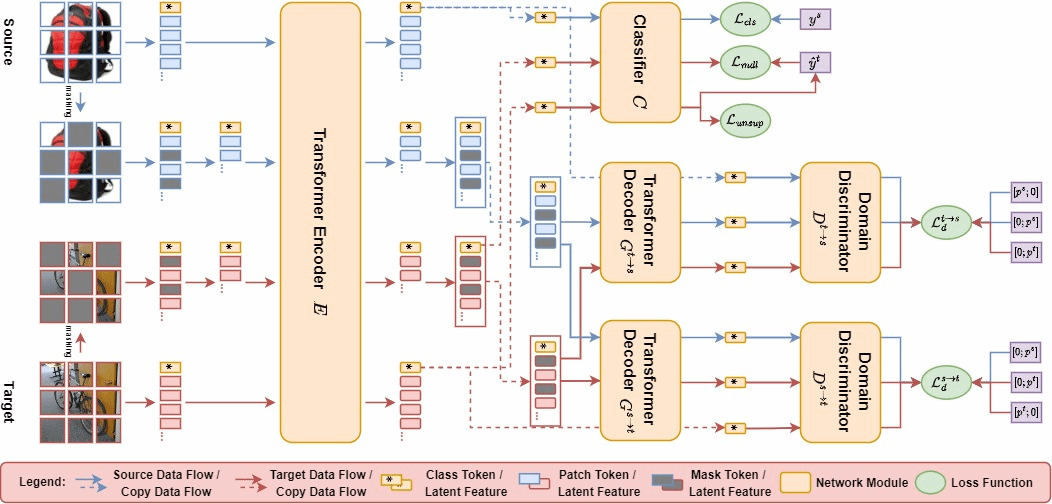
Overview of the Dual-MGAT framework.