Recently, the latest research from our School, titled "Optimal operation of an integrated energy system for a concentrated solar power plant based on a supercritical CO2 plume heat pump," was formally published in “Applied Thermal Engineering”, a leading international journal in the field of energy and thermal management.
The paper lists the School of Information Engineering, Nanchang University as its first affiliation. The work was completed by Professor Yang Xiaohui, graduate student Ma Quankai, Huang Zezhong, and their collaborators.
Integrated energy systems (IES) are an important vehicle for the efficient use of renewable energy, and coordinating deep decarbonization with multi-energy complementarity is a key open problem. In conventional IES, carbon-reduction equipment such as carbon capture and storage (CCS) and power-to-gas (P2G) suffers from bottlenecks, including system complexity and high cost, while standard ground-source heat pumps are limited in heat-source diversity and in the ability to actively reduce carbon emissions. Effectively coupling load-side cooling and heating supply with geological carbon storage remains an important challenge in this area.
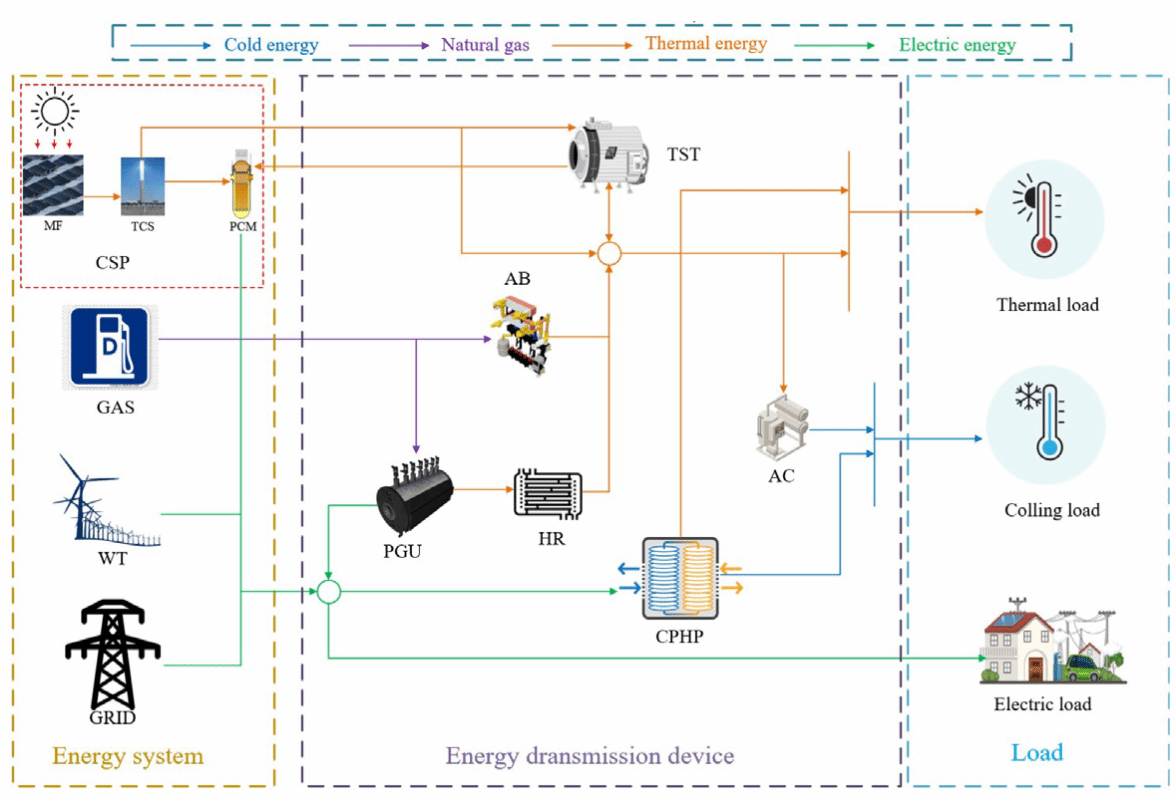
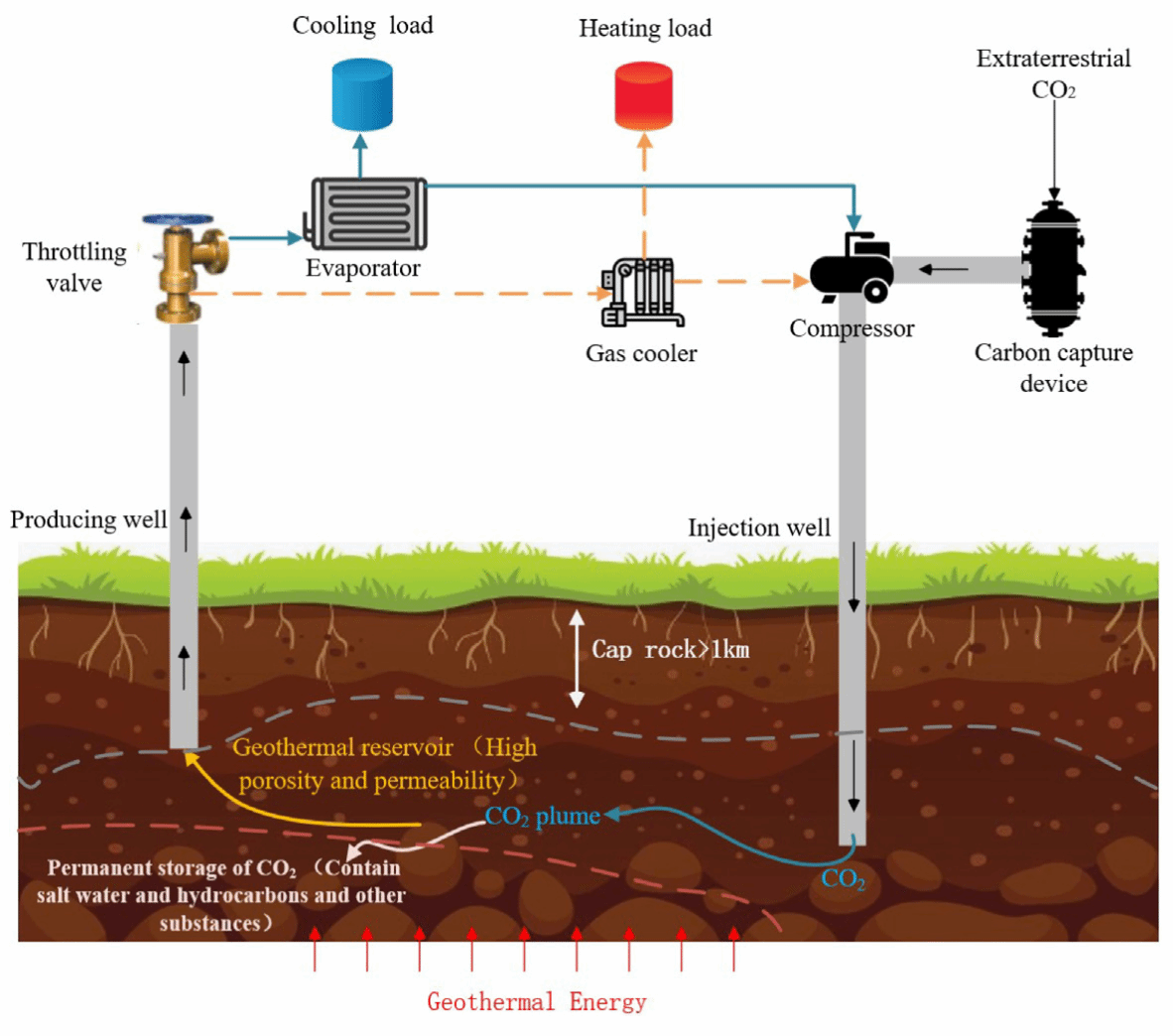
To address this problem, the research team was the first to propose a Solar–Geothermal Integrated Energy System (SGIES) that combines a concentrated solar power plant (CSP) with a supercritical CO2 plume heat pump (CPHP). Unlike conventional single-function device designs, the CPHP in this work couples supercritical CO2 heat-pump technology with CO2 geological storage, using supercritical CO2 as both the energy carrier and the storage medium. Under summer cooling and winter heating modes, the CPHP not only exploits the thermosiphon effect of supercritical CO2 to deliver clean cooling and heating loads, but also realizes permanent geological CO2 storage during plume migration. The study further designed an integrated storage-response strategy based on a stepwise carbon penalty and a green-certificate mechanism to optimize storage cost and used the thermal-storage capability of the CSP to shift thermal energy across time and space and dynamically match source and load.
Experimental and simulation results indicate that the proposed system shows clear advantages across multiple metrics. In energy output, the energy per unit area of the CSP system is 3.68 times that of a conventional photovoltaic/solar-thermal (PV/ST) system, while the land footprint is reduced by approximately one third, substantially easing land-use constraints. In carbon reduction and economic performance, the CPHP achieves additional CO2 storage through the coordination of heating/cooling supply and carbon storage, successfully replacing the conventional CCS/P2G system, reducing system complexity, and lowering costs. A multi-scenario comparative analysis shows that, under carbon-neutrality constraints, the CSP–CPHP coupled architecture reaches an overall performance-optimization rate of 34.38%.
The study does not rely on high-cost, standalone carbon-capture equipment. With an "energy–carbon flow coordination" approach, it unifies load supply and carbon storage within an integrated energy system. The results provide an economical and scalable closed-loop solution for "energy supply and carbon management" for industrial parks facing land constraints and deep-decarbonization pressure, offering key technical support for China's "dual-carbon" targets.